
What Exactly Is an Interior Designer? And What Is the 3-5-7 Rule in Interior Design?
If you’ve started planning a home renovation, chances are you’ve typed “interior designer near me” into Google and then landed straight into a rabbit hole of styling terms, mood boards, and design “rules” nobody explained properly. Two questions come up constantly: what does an interior designer actually do, and what is this 3-5-7 rule every design blog seems to mention?
This guide answers both — in plain language, with real examples you can use the same day.
What Exactly Is an Interior Designer?
An interior designer is a trained professional who plans, plots, and executes the layout, functionality, and aesthetics of indoor spaces — turning an empty or outdated home into something livable, efficient, and visually cohesive.
It’s easy to confuse this with interior decorating, but the two aren’t the same:
- Interior designers work on the structure of a space — room layouts, storage planning, lighting design, material selection, ergonomics, and sometimes even coordination with civil work like electrical points, false ceilings, and plumbing.
- Interior decorators focus purely on the surface-level styling — furniture, colors, textiles, and accessories — usually after the layout is already finalized.
What Does an Interior Designer Actually Do?
A typical interior designer’s scope covers:
- Space planning — deciding how every square foot is used, from your kitchen work triangle to your living room’s traffic flow.
- Budgeting — estimating material, labor, and furnishing costs before a single wall is touched. (This is exactly what a good interior cost calculator helps you do before you even meet a designer.)
- Material and finish selection — choosing between MDF, BWP ply, marine ply, or solid wood depending on your budget and climate.
- 3D visualization — giving you a preview of the finished space before execution begins.
- Vendor and contractor coordination — managing carpenters, electricians, and painters so the project stays on schedule.
- Styling and finishing touches — this is where design principles like the 3-5-7 rule come in.
If you’re comparing professionals for your project, it helps to look at our list of best interior designers before finalizing anyone — experience and portfolio matter just as much as pricing.
What Is the 3-5-7 Rule in Interior Design?
The 3-5-7 rule is a simple but powerful styling principle: group decorative items or furniture pieces in odd numbers — three, five, or seven — instead of even numbers or pairs.
Here’s why it works: the human eye is naturally drawn to imperfection. When objects are arranged in pairs, the brain reads them as a matched, static set and the eye simply “locks” onto the symmetry, moving on quickly. Odd-numbered groupings, on the other hand, force the eye to move between the objects, creating a sense of motion and rhythm across the arrangement. The result is a space that feels layered, natural, and intentionally curated — rather than staged or overly matched.
How to Apply the 3-5-7 Rule
The number you choose depends entirely on the scale of the surface or space you’re styling:
- Rule of 3 — best for small surfaces like a side table, console, or bathroom shelf. Think: a vase, a stack of books, and a small plant. Vary the height and shape of each item for the best effect.
- Rule of 5 — ideal for medium spaces such as a bookshelf, mantel, or kitchen open shelving. Mix textures and materials — ceramic, wood, glass — to add depth.
- Rule of 7 — used for larger, more elaborate displays like a gallery wall, a large console table, or an entryway console. At this scale, you can layer in taller and shorter elements to build a visual hierarchy.
Quick Styling Tips for the 3-5-7 Rule
- Vary height, not just quantity. Odd numbers alone won’t create balance — mix tall, medium, and short items within the group.
- Group by triangle, not a straight line. Arranging items in a loose triangular formation (one tall, two shorter, for example) reads more naturally than a straight row.
- Leave breathing room. Don’t crowd the grouping — negative space between items is what makes the arrangement feel curated instead of cluttered.
- Repeat a common element. Tie the grouping together with one shared color, material, or texture so it doesn’t look random.
This rule applies well beyond décor accessories too — it’s often used when planning layout designs for wall art clusters, pendant light groupings over dining tables, and even plant arrangements in balconies or living rooms.
Why These Basics Matter Before You Hire Anyone
Understanding what an interior designer does — and small styling principles like the 3-5-7 rule — puts you in a much stronger position when you start budgeting and hiring. You’ll know what you’re paying for, and you’ll be able to have sharper conversations with your designer about layout and styling choices.
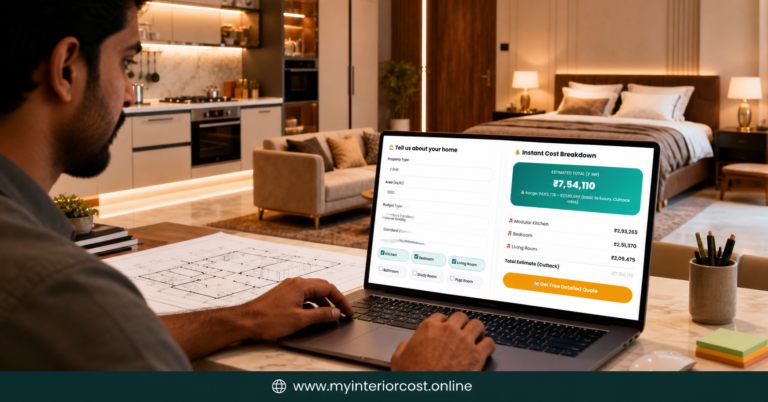
If you’re at the planning stage, the fastest next step is getting a realistic number in front of you. Use our free interior cost calculator to get an instant, city-adjusted estimate based on your BHK size, budget tier, and material preferences — no waiting on a designer’s callback required.
Frequently Asked Questions
Is an interior designer the same as an architect? No. Architects focus on structural design and building compliance — walls, load-bearing elements, and permits. Interior designers work within that structure to plan layouts, storage, lighting, and finishes.
Do I need an interior designer for a small apartment? Yes, if you want optimized storage and layout — smaller spaces often benefit the most from professional space planning, since every square foot needs to work harder.
Can I apply the 3-5-7 rule myself without hiring a designer? Absolutely. It’s one of the easiest DIY styling principles — start with the rule of 3 on a single shelf or table before scaling up.
Does the 3-5-7 rule apply to furniture too, or just décor? Both. It’s most commonly used for décor styling (vases, books, planters), but it also applies to furniture groupings like scatter cushions, stools, or wall art clusters.
How do I get an accurate cost estimate before hiring a designer? Use our interior cost calculator — it factors in your city, property type, budget tier, and material quality to give you an instant estimated range.
Planning your home interiors? Explore our gallery for design inspiration, browse top-rated interior designers, or contact us for a free personalized quote.